
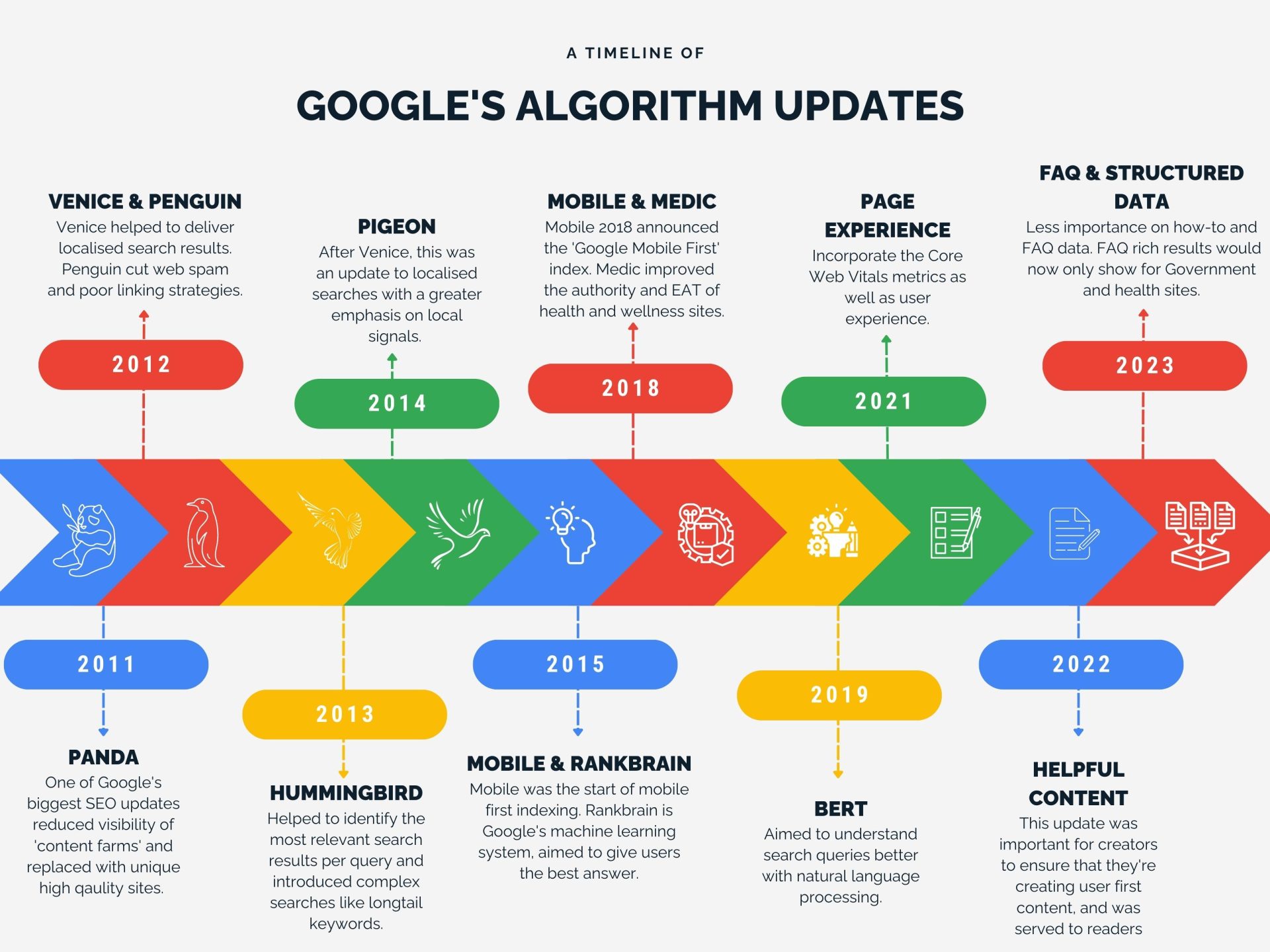
The Evolution of SEO: A Journey Through Google Updates
Over the past decade or so, the world of Search Engine Optimisation (SEO) has undergone a remarkable transformation, primarily driven by Google's continuous updates to its search algorithms. These updates have not only shaped the way websites rank in search results but have also forced SEO professionals to adapt and evolve their strategies.
Having been around in the industry for the majority of these updates I thought it would be interesting to take a retrospective journey through the major Google updates and their implications for the future of SEO.
Panda (2011)
Google Panda was one of the first major algorithm updates that aimed to penalise low-quality and duplicate content. Websites with thin or duplicated content saw a significant drop in rankings. This update emphasised the importance of high-quality, original content for SEO success.
Implication: Content became king, and SEO professionals started focusing on producing valuable, unique content.
Penguin (2012)
The Penguin update targeted websites that engaged in manipulative link-building practices, such as buying or spamming links. Google began penalising sites with unnatural link profiles, emphasising the importance of high-quality and relevant backlinks.
Implication: SEO shifted towards quality link building and a more holistic approach to off-page optimisation.
Hummingbird (2013)
Hummingbird marked a shift in how Google understood and interpreted user queries. This update introduced the concept of semantic search, enabling Google to better understand user intent and provide more relevant search results. In my humble opinion, this was a prelude to voice-activated search.
Implication: SEO professionals needed to focus on user intent and long-tail keywords to align with Google's improved search understanding.
Mobilegeddon (2015)
With the increasing importance of mobile devices, Google introduced Mobilegeddon, which prioritised mobile-friendly websites in mobile search results. Non-mobile-friendly sites were penalised. This seemed to be the beginning of Google's emphasis on good user experience being a ranking factor.
Implication: Mobile optimisation became a crucial aspect of SEO, as mobile traffic continued to grow.
RankBrain (2015)
RankBrain was Google's first foray into machine learning for search. It helped Google better understand the context of searches and delivered more relevant results.
Implication: SEO professionals needed to adapt to the evolving role of machine learning in search by creating content that could match user intent more effectively.
Fred (2017)
Google's Fred update targeted websites with low-quality content and excessive advertising. Websites with low-quality affiliate content were heavily impacted.
Implication: SEO professionals had to prioritise user experience and high-quality content while avoiding overly aggressive monetisation strategies.
BERT (2019)
In 2019 Google introduced a neural network-based technique for natural language processing (NLP) pre-training called Bidirectional Encoder Representations from Transformers, or BERT for short. The BERT update was a major leap in Google's understanding of natural language. It aimed to understand not only the intent of the user but the context of words in a sentence, allowing Google to provide more precise search results.
Implication: SEO strategies shifted towards natural language content and conversational search optimisation.
Core Web Vitals (2021)
Core Web Vitals became a ranking factor, focusing on page loading speed, interactivity, and visual stability. This update emphasised the importance of a seamless user experience.
Implication: SEO professionals needed to prioritize website performance, user experience, and technical optimisation.
What It Means for SEO
The evolution of SEO over the last 10+ years has been marked by Google's continuous efforts to provide users with better search results. As a result, SEO professionals have had to adapt and refine their strategies accordingly:
Content Quality: High-quality, valuable, and original content is essential. Google's focus on user intent and semantic search means that content should address the specific needs and questions of users.
Link Building: The emphasis is on quality over quantity when it comes to backlinks. Building relevant and authoritative backlinks is crucial for SEO success.
Mobile Optimisation: With the majority of internet traffic coming from mobile devices, ensuring that websites are mobile-friendly is non-negotiable.
User Experience: Providing a seamless and enjoyable user experience is vital. Core Web Vitals and page speed optimisation have become integral to SEO strategies.
Machine Learning: Understanding how machine learning, like RankBrain and BERT, affects search results and adapting content accordingly is essential.
For over a decade we have seen a remarkable evolution in SEO, driven by Google's algorithm updates. SEO professionals have had to continuously adapt to these changes, emphasising content quality, user experience, technical onpage updates and the evolving role of machine learning in search. As we move forward, staying agile and keeping up with Google's updates will remain critical for SEO success.
Image: https://thephagroup.com/