AI Text Watermarks Explained: What Claude, Gemini & ChatGPT Changes Mean for Your Business
AI Text Watermarks Have Arrived.
Here's What They Actually Do (and Don't)
A balanced look at Claude, Gemini and ChatGPT's move to watermark AI-generated text, what businesses need to know, and why a growing removal-tool ecosystem is already testing its limits.
Since August 2026, Claude has been quietly embedding an invisible signal into every piece of text it writes. Google has been doing something similar with Gemini for longer. OpenAI has confirmed ChatGPT is next. If your business writes with AI, even occasionally, this now touches your content whether you asked for it or not.
Here is what is actually happening, why it is happening now, and why the honest answer to “does this fix AI slop” is more complicated than the announcements suggest.
What changed, in plain terms
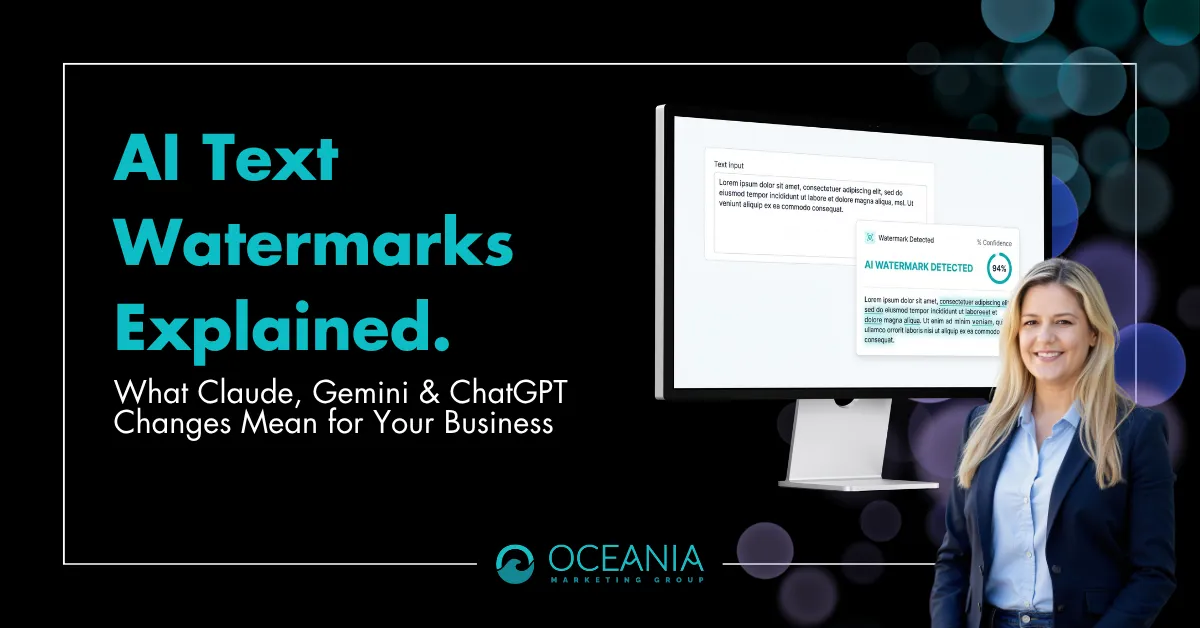
From 2 August 2026, new Claude models embed a watermark directly into the text they generate. Anthropic describes it as imperceptible to a reader and built on the same underlying approach as Google DeepMind's SynthID-Text, first published in 2024. Rather than adding characters or editing a finished response, the method changes how the model selects some of its next words during generation, biasing token choices in a pattern that is statistically invisible to a human but detectable by a matching algorithm.
The trigger is the European Union's AI Act. Article 50 requires providers of general-purpose AI systems to make AI-generated content detectable in a machine-readable format, and around 190 companies, including Anthropic, Google, Meta, Microsoft and Mistral, signed the EU's voluntary Code of Practice on Transparency of AI-Generated Content that gives signatories a presumption of compliance. Anthropic is rolling the watermark out globally rather than restricting it to EU users, explaining it does not yet have a reliable way to apply it by region.
Google has watermarked Gemini's images since 2023 and has since extended SynthID to text, audio and video. OpenAI has reportedly had text-watermarking technology ready for some time but had not deployed it, reportedly over concerns about false positives and about giving competitors a way to fingerprint ChatGPT usage. That reluctance is now shifting: OpenAI has told its own support channels that its goal is to “expand provenance signals to all modalities including text” to meet its transparency obligations under the same EU code. In effect, all three labs are converging on watermarked text within the same year, for the same regulatory reason.


What this means for your business
A few practical points worth flagging before this becomes background noise:
It travels with the text. The watermark survives copy-and-paste out of the chat window and into your CMS, your email client, or your client's Word document. It is embedded in the words themselves, not the platform.
Editing lightly probably will not remove it. Anthropic's own documentation says light editing likely will not strip the watermark, while a complete rewrite where every word is replaced probably will, at which point it is fair to ask whether the text can still be called AI-generated at all. This matters for any workflow where AI drafts and a human edits, which is most professional use of these tools today.
It marks involvement, not authorship. A detected watermark tells you Claude was likely involved with a piece of text at some point. It cannot distinguish “Claude wrote this” from “Claude proofread this” or “Claude translated this.” Anthropic has confirmed that using Claude to correct spelling or translate a document you wrote yourself will still carry the mark, because every word passed through the model's token selection at some point. The absence of a watermark, equally, is not proof of human authorship.
A detection API is coming. Anthropic has said it plans to release a watermark detection tool “that you can use yourself,” separate from third-party AI-detection products like Pangram, which look for stylistic patterns rather than checking for a cryptographic signal. Once that ships, clients, publishers or regulators will be able to check text against Claude specifically, not just guess based on tone.
Enterprise and API use is in scope. This is not limited to the consumer chat app. The marking applies wherever a supported Claude model is used, including the API, Claude Code and other integrations, so if AI-assisted content sits anywhere in your production pipeline, this now applies to that pipeline too.
Is this actually a quality measure, or something else?
Anthropic's own framing is about giving people “useful context about the information they consume,” and that is a reasonable transparency goal on its own terms. But it is worth being honest about what watermarking does and does not solve.
A watermark says nothing about whether a piece of writing is accurate, useful, well-reasoned or worth reading. It cannot flag a hallucinated statistic, a weak argument or generic, low-effort copy, the kind of output people mean when they say “AI slop.” A beautifully researched, carefully edited piece written with AI assistance carries exactly the same statistical signal as a low-effort, unchecked one. Watermarking is a provenance tool, not a quality filter, and treating it as the latter overstates what it actually does.
What it is better understood as is a mechanism to make bulk, unedited AI output traceable back to its source at scale, which is a different and narrower goal than “stopping AI slop.” It gives platforms, search engines and downstream tools a way to identify content that passed through a given model with minimal human intervention, which is useful for content moderation, dataset hygiene and regulatory compliance. Whether it meaningfully improves what readers actually see is a separate question, and the honest answer right now is: probably not directly. It is a labelling system, not an editorial one.
The watermark-removal problem, and why it undercuts the pitch

Here is the part that deserves more scrutiny than most coverage has given it: within days of Anthropic's announcement, tools claiming to strip these exact watermarks were already circulating.
An open-source tool built by an independent developer added support for stripping Claude, Gemini and OpenAI provenance signals within about a week of Anthropic's confirmation, spanning multiple file formats and released under an open licence. Commercial “watermark bypass” services, some charging for API access, now advertise removal for SynthID and equivalent systems across text and images. Several GitHub projects dedicated to defeating invisible AI watermarks in images already exist, and text-focused tools that claim to rewrite content at the token level specifically to break the statistical signal are live and marketed openly.
It is worth separating two different claims here, because the coverage often blurs them. Stripping file metadata, such as C2PA provenance tags attached to images or documents, is trivial and has always been possible; that is a solved problem and always was. Defeating the statistical watermark embedded in the text itself is a genuinely harder, unverified problem, and most removal tools cannot actually prove their rewrites survive detection against Anthropic's undisclosed detector, since no public version of that detector exists to test against. Viral claims of “watermarks defeated” are frequently based on passing an open-source detector that is not the one the original lab actually uses.
Even so, Anthropic itself has conceded the underlying point. An Anthropic engineer confirmed publicly that the system “is not perfect, you can edit it, but it's a first step,” and the company's own documentation acknowledges that proofreading, translation, heavy paraphrasing or short outputs can all cause the watermark to go undetected. That is a significant admission: a compliance and transparency measure whose creator has stated, on the record, that a moderately motivated user can likely work around it with an editing pass, and where third-party tools claiming to automate that workaround appeared within roughly a week of the launch.
There is also an asymmetry worth naming plainly. A watermark has to survive nearly anything a user might do to a piece of text; someone trying to defeat it only needs to find one method that works. That is a structurally difficult position to defend from, and it is one reason OpenAI reportedly held off shipping its own text watermark for years, having found in an internal survey that a meaningful share of users would use the product less if it were added, alongside concerns about false positives.
None of this makes the watermark pointless. It raises the floor for casual, low-effort misuse and gives platforms a real signal to work with in aggregate. But it is fair to ask whether a transparency measure that a first-week open-source tool can plausibly disrupt is actually solving the problem its announcement implied it would solve, or whether it is better understood as a compliance checkbox with a genuine but modest practical effect.
Who is actually at risk here
The people most exposed are not the ones deliberately trying to hide AI use. They are the ordinary professional workflows that never expected to be tested in the first place: a marketer who used Claude to tighten a draft they wrote themselves, a student who ran an assignment through AI for proofreading, a business using AI-assisted copy across a website without disclosure policies in place. Because the watermark cannot distinguish authorship from assistance, and because detection tools are becoming more accessible, content that was only lightly AI-assisted can register the same as content that was fully generated, with no context attached to explain the difference.
For agencies and marketing teams specifically, the practical exposure sits less in the watermark itself and more in what clients, platforms or regulators start doing with detection once it is easy to run. A watermark on its own has no teeth. A watermark plus a client contract that requires disclosure, or a platform policy that treats AI content differently, is where the actual risk lives, and that is a policy and process conversation businesses should be having now, not after a detection tool flags something.
Where this leaves businesses right now
Treat watermarking as a compliance and provenance layer, not a quality or ethics solution. It changes very little about how AI-assisted content should be produced and checked. The fundamentals still apply: verify facts, edit substantively rather than lightly, and be honest in client agreements about where and how AI tools are used in delivery. A watermark will not catch a bad brief, an unchecked statistic or generic output, and it should not be mistaken for editorial quality assurance. Businesses that already have solid human review built into their content process have little to worry about. Businesses relying on unedited AI output at volume now have a traceability problem they did not have a fortnight ago, whether or not a removal tool can defeat it in practice.
Oceania Marketing Group uses AI tools as part of a senior, human-led strategy and delivery process, never as a replacement for it. If you want a second opinion on how AI content fits into your marketing without compromising quality or compliance, get in touch.