Digital duty of care in Australia: what small businesses and web agencies need to check
What is Australia's digital duty of care?
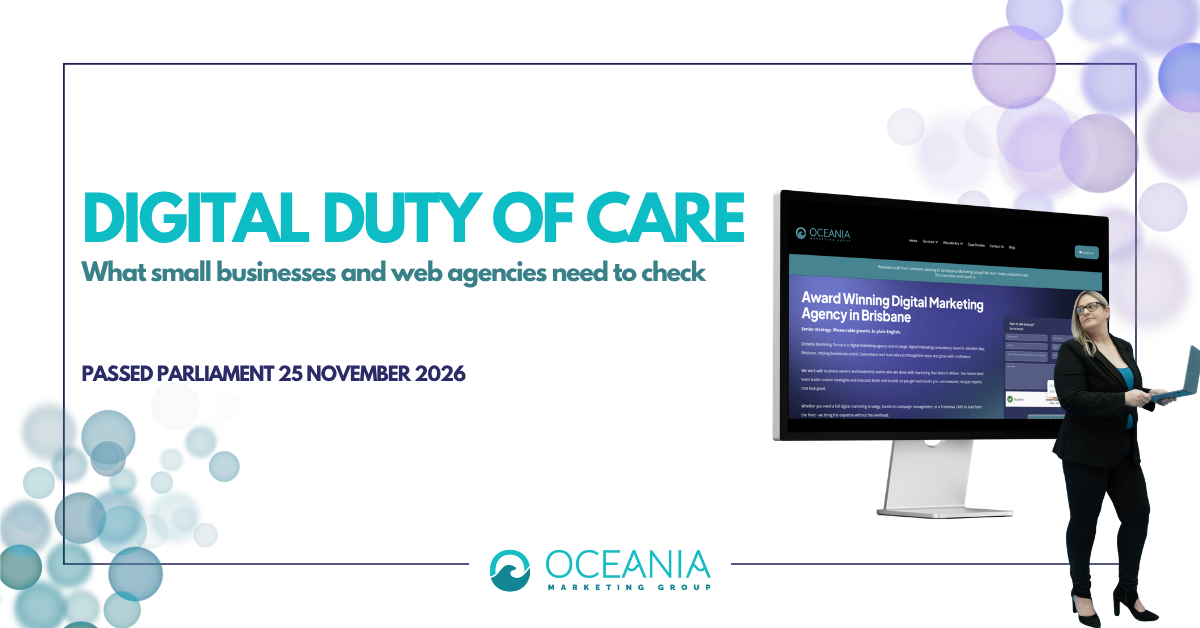
The digital duty of care is a new legal obligation on online services to protect the people using them. The Minister for Communications, Anika Wells, announced on 25 November 2026 that the Digital Duty of Care had passed Parliament.
The core of the duty, as described by law firm Johnson Winter Slattery, is that a service must "take appropriate action" to ensure a safe online environment. Protections for children are stronger, including rules about harmful content, addictive design features and AI chatbots that simulate emotional intimacy.
A note on timing: media reports say royal assent was still pending after the vote. The government describes the start date as 12 months away, so most businesses have until late 2027 before the main duty applies.
Who does the digital duty of care apply to?
This is the question that matters for small businesses, and the honest answer is that it is broader than most people expect.
The duty applies to "online services". The September exposure draft listed social media, messaging, websites (as designated internet services), search engines, app stores, hosting and AI services, with no threshold for user numbers or turnover. MediaNama's analysis of the passed bill described it as covering almost any service people in Australia can reach online.
The Minister's own announcement focuses on apps, games, social platforms and AI chatbots. It does not say that every ordinary business website is caught. But until the law is read alongside the exemption rules, a website with interactive features should assume it is in scope.
The duty falls on the provider, or the person who exercises the greatest degree of day-to-day control over the service, according to JWS's reading of the bill. For a business that has handed its website to an agency, that question of control matters.
Is there a small business exemption?
Not in the law itself. On 23 November, two days before the vote, the Minister said low-risk business websites would be exempt, using a café or bookkeeper as examples (SBS; The Lawyer). TechTimes reported the same day that the bill had no automatic small business exemption, and that any exemption would come later through a ministerial instrument, after advice from the eSafety Commissioner.
Small business groups wanted it written into the bill. The Council of Small Business Organisations Australia said the exemption "needs to be clearly written into the legislation" (COSBOA via Mirage News, 23 November).
Tax agent Belinda Raso, co-founder of the Stop the Ambition Tax campaign, made the same point in a Facebook video from Tax Invest Accounting before the vote. She called the promised exemption "a small win", but said it needed to be legislated as part of the bill before it passed Parliament.
It was not. That means the protection for low-risk websites depends on an instrument that has not been written yet, and "low risk" has not been defined.
What does a website risk assessment involve, and who does it?
Under the exposure draft, a responsible person must assess the risks of their service at least once a year, and again before any significant change. Records must be kept for six years and given to the eSafety Commissioner within 30 days if requested. Treat the detail as subject to the final text and to eSafety guidance, which has not yet been published.
The business does the assessment itself. SmartCompany reported that the proposed assessments would not automatically require businesses to hire external auditors. The Australian Computer Society disagrees with leaving it there: it wants qualified assessors so the process does not become, in its words, "a box-ticking exercise" (ACS, 10 November).
In practice, a risk assessment for a small website asks simple questions. Can users post, upload or message each other? Do you run a chatbot? Could a child use the service? What could go wrong, and what have you done about it?
How much will it cost?
Nobody has published an official cost per website. The government's impact analysis estimated average regulatory costs for Australian businesses of about $1.408 million a year in total, not per business (Office of Impact Analysis, September 2026). COSBOA told SmartCompany it had not calculated the potential costs. Legal analysis of the bill by Johnson Winter Slattery also says cost cannot be taken into account when deciding what action is appropriate.
The only per-site figure on the record is an estimate from agency owner Karl Morris of Goop Digital: "a couple of hundred bucks, but it could be thousands" (SmartCompany). Treat that as one agency's view.
The bigger cost risk is the penalty regime. Maximum penalties for companies are 5% of global turnover or $109.2 million, whichever is greater, according to the government. Individuals and groups can also now sue an online service whose breach caused them harm, a right added by the Senate (the Minister's announcement). Those maximums are aimed at large platforms, but they show how seriously the duty is meant to be taken.
What if you run multiple websites?
The duty attaches to each online service, not to the business as a whole. On the safest reading, that means a separate risk assessment for each website or platform you run (Enod Works suggests one or two pages per service is a reasonable start).
Agencies are exposed too. If an agency hosts, configures and runs a client's website day to day, it may be the person with the most control. Karl Morris told SmartCompany the law could affect all 800 websites his agency manages.
Who will be hardest hit?
Multi-site operators: franchise groups, property and finance brokers with landing pages, and anyone running separate sites for each brand or location.
Websites with interactive features: chatbots, comment sections, forums, member logins, file uploads and customer messaging all raise the risk profile.
Digital agencies and developers: they may share the duty for sites they control, and clients will expect them to have answers.
Small businesses without in-house expertise: the ACS warns small businesses "can least afford to get an assessment wrong".
Simple brochure and booking websites are the most likely to be exempted, once the Minister acts.
What should small businesses and web agencies do now?
Do not rush to buy a compliance product. You have about 12 months, and the exemption rules and eSafety guidance will change what is needed. Instead, get organised:
List every website, landing page, app and chatbot your business runs, including old campaign pages that are still live.
Note the interactive features on each one: chat, comments, logins, uploads, reviews and AI tools.
Work out who controls each site day to day: you, your agency or a platform. Put it in writing in your agency agreement.
Switch off what you do not use. An unused comment section or forum is risk with no reward.
Check your chatbot settings, especially anything a child could use, and keep a record of the safeguards.
Watch for the exemption instrument and eSafety guidance before committing to any paid assessment.
If you want a second opinion on your websites, chatbots and AI tools, our AI visibility audit already reviews how your site works with AI, and our website and landing page design and GoHighLevel teams can help you simplify what you run.
Frequently asked questions
What is the digital duty of care legislation?
It is an amendment to Australia's online safety laws, passed by Parliament on 25 November 2026, that requires online services to take appropriate action to keep Australian users safe, with stronger protections for children.
When does the digital duty of care start?
The government says it comes into effect 12 months after it becomes law. Some eSafety powers, such as removing nudify apps, start sooner.
Does the digital duty of care apply to my small business website?
Possibly. The law covers online services broadly and has no built-in small business exemption. The Minister has promised to exempt low-risk business websites by ministerial instrument, but that has not happened yet.
Do I need an external auditor for a risk assessment?
Not automatically. Reporting on the bill says businesses can do their own assessment, keep records for six years and provide them to the eSafety Commissioner if asked. The ACS recommends using qualified assessors.
What powers does the eSafety Commissioner have under the new law?
The Commissioner can request risk assessments, set complaint standards, issue removal notices and pursue civil penalties. Maximum penalties are 5% of global turnover or $109.2 million for companies, whichever is greater.
This article is general information, not legal advice. The law, exemption rules and eSafety guidance are still being finalised. Check the official sources and get legal advice for your circumstances.
Sources
Minister Anika Wells, Australia's Digital Duty of Care becomes law, 25 Nov 2026
Exposure draft, Online Safety Amendment (Digital Duty of Care) Bill 2026, Sep 2026
Office of Impact Analysis, Digital Duty of Care model for online safety, Sep 2026
SBS News, Small businesses spared from online crackdown, 23 Nov 2026
TechTimes, Wells promises small business exemption; bill has none yet, 23 Nov 2026
The Lawyer, Parliament passes Digital Duty of Care legislation, 25 Nov 2026
Fast Company / AP, Digital Duty of Care Act passes in Australia, Nov 2026
COSBOA via Mirage News, Small business awaits Senate's final sitting week, 23 Nov 2026
Australian Computer Society, Online safety needs qualified assessors, 10 Nov 2026
Enod Works, Digital Duty of Care: a guide for small businesses
Tax Invest Accounting (Belinda Raso), Facebook video, Nov 2026