Google Search Console Can Now Show Your AI Search Visibility: What It Means for Australian Businesses
For the past two years, Australian business owners have been told the same thing about AI search: it matters, it’s growing, and you need to show up in it. All true. But there’s been a frustrating gap, no real way to measure whether you actually were showing up. We’ve been optimising in the dark.
That just changed. On 3 June 2026, Google Search Central announced new generative AI performance reports inside Google Search Console, the free tool most businesses already use to track their Google performance. For the first time, Google will show you how visible your website is inside its AI answers.
Here’s what’s been launched, what it does and doesn’t tell you, and what it means for your business.
What Google Actually Launched: AI Search Visibility Reporting
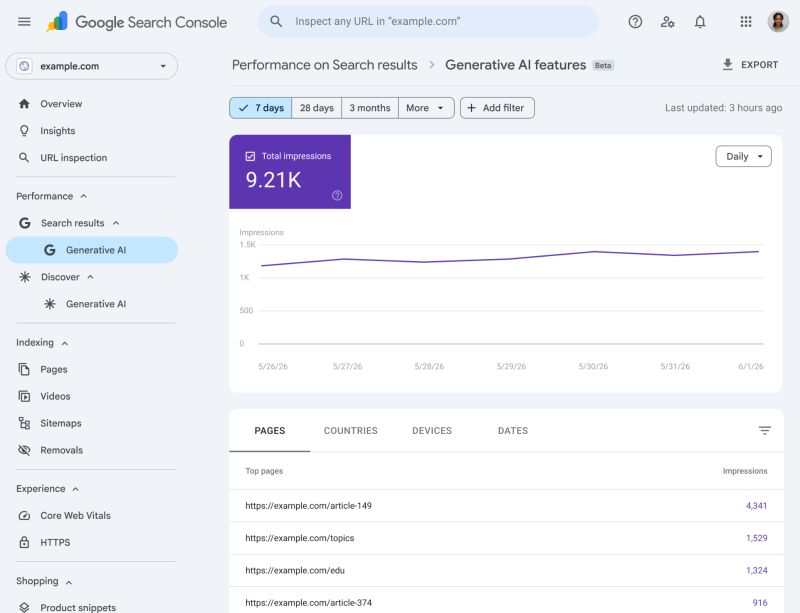
Google Search Console now includes dedicated reports showing your visibility inside Google’s AI-powered search features. Until now, that data was bundled invisibly into your overall performance numbers, you couldn’t tell a click from a normal blue link apart from an appearance inside an AI answer. Now you can see it separately.
The reports cover two areas: generative AI features in Search, which includes AI Overviews (the AI summaries above the results) and AI Mode (Google’s conversational answer experience), and generative AI features in Discover, the personalised content feed on mobile.
WHAT THE REPORTS SHOW (AND WHAT THEY DON'T)
You get: Impressions (how often your pages appeared in AI features), the specific Pages that appeared, Countries, Devices, and Dates, down to hourly, daily, weekly or monthly views.
You don't get (yet): click data or the search terms people used. Google says it plans to add more metrics over time. For now, treat this as a visibility signal, not a traffic report.
Where Does Search Console Get This Data?
This is worth understanding, because it’s easy to assume the report does more than it does. The data is Google’s own first-party data, drawn from the same pipeline as the rest of Search Console. When one of Google’s AI features actually shows or cites a page from your site to a real person, that gets logged as an impression. It’s based on what Google genuinely served, not a simulation, and not a sample of test questions run against a chatbot.
That also defines its limits. The scope is strictly Google’s own AI surfaces: AI Overviews and AI Mode (both powered by Google’s Gemini model), plus generative AI features in Discover. It does not track other AI tools such as ChatGPT, Perplexity, Microsoft Copilot, or even Google’s standalone Gemini app, because Google can only report on what Google itself shows.
What this means for you: Search Console will be your source of truth for visibility inside Google’s AI answers, the biggest AI search surface for Australian audiences by far. But it’s one engine, not the whole AI landscape. If you want to know how your business appears across other answer engines like ChatGPT or Perplexity, you’ll need separate, third-party AI-visibility tools. It’s also page-level, not brand-level: it tells you which of your pages appeared, not how your brand was described or whether a competitor was named alongside you.
There’s also a second, related change worth knowing about. Google is testing a setting that lets a website opt out of appearing in AI Overviews, AI Mode and AI Overviews in Discover. A site that opts out keeps its normal place in regular search results and the Discover feed, but gives up any visibility, and any traffic, from those AI features. We’ll come back to why that matters.
Why This Is a Big Deal
It might sound like a small reporting tweak. It isn’t. This is the first time Google has given businesses an official, dedicated way to measure their presence in AI search, something the industry has been asking for since AI Overviews launched in 2024.
It also quietly confirms something important: appearing inside AI answers is now a measurable marketing outcome in its own right. The work of making your business visible to AI, what the industry calls GEO (generative engine optimisation) or AI SEO, is no longer a vague “nice to have.” Google itself is now putting numbers against it.
What It Means for Australian Businesses
It’s coming, but it isn’t here for most of us yet. Google is rolling the reports out to a limited group of websites first, starting in the United Kingdom, with no confirmed date for Australia or a global release. So if you log into Search Console today and don’t see an AI report, that’s expected. The smart move is to get ready now, not to wait until it lands.
Impressions without clicks need careful reading. Seeing your pages appear in AI answers is genuinely useful, but a big impression count won’t always translate into visits, because AI often answers the question on the page. Read the report as a measure of influence and visibility, and pair it with your website analytics to understand the full picture.
The opt-out toggle is a real strategic decision. Some businesses, especially publishers, will be tempted to opt out of AI features to protect their content and clicks. For most Australian service and local businesses, though, opting out means disappearing from the fastest-growing part of search. It’s a decision to make deliberately, with eyes open, not a default to flip on.
Your data is only as good as your setup. These insights live in Google Search Console. If your site isn’t verified, or you’ve never really used it, now is the time to fix that, so the moment the AI report reaches Australia, you have clean historical data to compare against.
What You Should Do Now
• Make sure Google Search Console is set up and verified for your site, with the right people having access.
• Baseline your current performance so you can see the before-and-after once AI reporting arrives in Australia.
• Keep investing in the fundamentals that drive AI visibility: accurate structured data (schema), genuine question-led content, real authority signals and consistent business information across the web. These are what earn AI impressions in the first place.
• Decide your position on AI features deliberately. For most businesses, being visible in AI search is an opportunity, not a threat to manage by opting out.
• Watch for the rollout and be ready to act on the data the day it appears in your account.
The Bottom Line
For two years, AI search visibility has been something we could influence but never properly measure. Google has just started to close that gap. The reports aren’t perfect, and most Australian businesses can’t see them yet, but the direction is clear: AI visibility is now a measurable, manageable part of your marketing, and the businesses that prepare for it will be the ones making confident, data-backed decisions while everyone else is still guessing.
Frequently Asked Questions
What are Google’s Search Generative AI performance reports?
They are new reports inside Google Search Console, announced on 3 June 2026, that show how often your website’s pages appear within Google’s generative AI features: AI Overviews and AI Mode in Search, plus generative AI features in Discover. They give you a dedicated view of your AI search visibility, separate from your standard search performance.
What do the reports show, and what don’t they show?
They show impressions (how often your URLs appeared in AI features), which pages appeared, and breakdowns by country, device and date, with hourly to monthly granularity. They do not yet include click data or the search terms people used. Google has said it plans to add more metrics over time, so treat the current reports as a visibility signal rather than a full traffic report.
Are the AI performance reports available in Australia yet?
Not for most sites. Google is rolling the reports out to a limited subset of websites first, beginning in the United Kingdom, and has not confirmed a date for Australia or a wider global release. The best approach is to prepare now so you can use the data as soon as it reaches your account.
What is the AI opt-out toggle, and should I use it?
Alongside the reports, Google is testing a setting that lets a website opt out of appearing in AI Overviews, AI Mode and AI Overviews in Discover. A site that opts out keeps its normal place in regular search results and Discover but gives up visibility and traffic from those AI features. For most Australian service and local businesses, opting out means vanishing from the fastest-growing part of search, so it’s a decision to make carefully rather than a default.
How is this different from the normal Search Console performance report?
The generative AI data was already counted inside your overall Search Console performance figures. You just couldn’t separate it out. The new reports give you a dedicated lens on AI features specifically, so you can finally tell AI-driven visibility apart from traditional search visibility. Your standard performance report doesn’t go away.
Does the report track ChatGPT, Perplexity and other AI tools?
No. The reports cover only Google’s own generative AI features (AI Overviews and AI Mode in Search, plus generative AI in Discover) using Google’s first-party data on what it actually showed users. They don’t track other answer engines such as ChatGPT, Perplexity or Microsoft Copilot, or Google’s standalone Gemini app. To monitor your visibility across those, you’d need a separate third-party AI-visibility tool.
How does this relate to GEO and AI SEO?
GEO (generative engine optimisation), often used interchangeably with AI SEO, is the practice of making your business visible to and trusted by AI-powered search. These new reports are the measurement layer for that work: they help you see whether your GEO efforts (structured data, authoritative question-led content and consistent business information) are actually getting you cited in AI answers.
Want to be ready for AI search reporting before your competitors are? At Oceania Marketing Group, we help Australian businesses get found, understood and recommended in AI search, from Search Console setup to the GEO and AI SEO work that earns you a place in AI answers. If you’d like a clear picture of where you stand, let’s have a conversation.